You've heard it time and time again, SHOW DON'T TELL. If you have crit partners you've probably gone cross-eyed from reading it in your ms at one time or another. But you're past that now. You've worked hard on your prose, you're showing all over the place. Or are you?
Using internal physical reactions is a quick way to show a character's emotions. You've seen sentences like these:
My heart raced with fear.
Nervousness twisted her stomach.
These sentences seem, on the surface, that they're showing but in reality, they're telling. Why? Because it tells us what emotion the character is feeling. Fear, in the first sentence, and Nervousness in the second. Chances are, if the physical reaction is appropriate to the scene, that the naming of the emotion is simply excess information. This is sometimes called tagging your emotions and it's usually unnecessary.
In this case, that extra info creates a distance between the reader and the character. In a tense or emotional situation, the reader should be right there with the character, experiencing and connecting to everything the character feels. When something happens that causes your character's heart to pound your reader feels it, when you add in "with fear" you push your reader back a step because they're forced to process an external observation.
Think about it. When you're in the middle of a scary situation, you might notice your heart is pounding but do you actually think - hey my heart is pounding because I'm afraid? No. You just feel afraid.
I work with the rule of thumb that unless a character is experiencing an emotion that is unexpected (like, rather than fear, a character's heart pounds with excitement at being chased by an axe murderer) there's no need to name it. If you've done a good job at creating your character and revealing what makes them them to the reader, they will know what your character is feeling. And even more than that, they will feel a part of that character's experience.
Trust your reader! You don't have to explain everything to them.

Showing posts with label tips. Show all posts
Showing posts with label tips. Show all posts
Tuesday, June 8, 2010


Thursday, June 3, 2010
Invoking the Senses in Description
When writing description or "setting the scene" it's important that you tell us more than just what something looks like.
When setting a scene use at least three of the five senses in the description.
I've seen it said many times, so I'm not sure who said it first but most recently, Ellen Hopkins spoke at my local SCBWI conference on this.
One thing she said that really stuck with me is that everyone has one or two senses that they respond to and focus on the most. While it's true that most people are visual and it's important for the reader to understand what they should be "seeing" it's not the only thing that draws a reader into a scene. Some people react strongly to smell, others to sound, or touch. If you leave those out, you could be distancing whole groups of readers who "can't connect" to your writing.
What are the five senses?
- Sight
- Hearing
- Smell
- Touch
- Taste
(and for writing purposes I like to include/separate internal - both physical and emotional - ie. heart pounding, etc.)
I think most of us tend to focus heavily on the visual when writing so, for example, if you want to set the scene as a summer evening at sunset you might say:
It was a typical summer evening. The sun was just setting behind the trees, coloring the sky in bands of red, gold, and purple.
That's nice, but it doesn't really give the full sense of what it's like to really be there.
Now here's the same night with the rest of the senses added in:
It was a typical summer evening. The sun was just setting behind the trees, coloring the sky in bands of red, gold, and purple. A slight breeze tickled the hair on my arms as it rustled the leaves of the Maple trees and carried the scent of the rosebushes throughout the yard.
See how incorporating touch (tickling), sound (leaves rustling), and smell (scent of the rosebushes) adds depth to the scene? There's something for everyone to relate to and it's accomplished in three fairly short sentences. It's succinct enough not to drag down your story, and active enough to not feel boring and/or tacked on.
If you wanted to add in some internal physical/emotional sense that also helps to set the scene before diving into the story, you might add on something like:
Even with the sun sinking, the heat of the day still pressed down around me, making even the smallest movement feel exhausting. -- But you know, say it better than that!
I find this tip most helpful during revision when I'm trying to flesh out scenes. If there's a scene you have that's not quite working take a look and see if there are some senses missing. They might be just what you need to turn a moment into an unforgettable MOMENT.
Pay attention to what senses you focus on the most. After Ellen pointed out that everyone has a dominant sense I realized I tend to focus mostly on the sight and touch and rarely mention sound unless it's plot specific. This helped me immensely in the re-write process.
If you think about it, the moments we remember most in books are the ones that we can really connect to and feel like we know exactly what the character is experiencing.
Re-read some of your favorite scenes and see how much sensory detail is included. If it's done well it's invisible and yet it totally adds to the overall experience.
I wanted to post an example from a published book but I don't have it with me. So I'll just tell you that one author I noticed that does this really well, is Kelley Armstrong. The particular scene I'm thinking of takes place in The Awakening, and at the beginning of the chapter, she completely creates the setting in about three short sentences. I'm going to have to get my hands on that book again and come back and post it.
What about you? What senses do you focus on the most? What are some great scenes (or great authors) you've read that suck you in with all your senses?
I've seen it said many times, so I'm not sure who said it first but most recently, Ellen Hopkins spoke at my local SCBWI conference on this.
One thing she said that really stuck with me is that everyone has one or two senses that they respond to and focus on the most. While it's true that most people are visual and it's important for the reader to understand what they should be "seeing" it's not the only thing that draws a reader into a scene. Some people react strongly to smell, others to sound, or touch. If you leave those out, you could be distancing whole groups of readers who "can't connect" to your writing.
What are the five senses?
- Sight
- Hearing
- Smell
- Touch
- Taste
(and for writing purposes I like to include/separate internal - both physical and emotional - ie. heart pounding, etc.)
I think most of us tend to focus heavily on the visual when writing so, for example, if you want to set the scene as a summer evening at sunset you might say:
It was a typical summer evening. The sun was just setting behind the trees, coloring the sky in bands of red, gold, and purple.
That's nice, but it doesn't really give the full sense of what it's like to really be there.
Now here's the same night with the rest of the senses added in:
It was a typical summer evening. The sun was just setting behind the trees, coloring the sky in bands of red, gold, and purple. A slight breeze tickled the hair on my arms as it rustled the leaves of the Maple trees and carried the scent of the rosebushes throughout the yard.
See how incorporating touch (tickling), sound (leaves rustling), and smell (scent of the rosebushes) adds depth to the scene? There's something for everyone to relate to and it's accomplished in three fairly short sentences. It's succinct enough not to drag down your story, and active enough to not feel boring and/or tacked on.
If you wanted to add in some internal physical/emotional sense that also helps to set the scene before diving into the story, you might add on something like:
Even with the sun sinking, the heat of the day still pressed down around me, making even the smallest movement feel exhausting. -- But you know, say it better than that!
I find this tip most helpful during revision when I'm trying to flesh out scenes. If there's a scene you have that's not quite working take a look and see if there are some senses missing. They might be just what you need to turn a moment into an unforgettable MOMENT.
Pay attention to what senses you focus on the most. After Ellen pointed out that everyone has a dominant sense I realized I tend to focus mostly on the sight and touch and rarely mention sound unless it's plot specific. This helped me immensely in the re-write process.
If you think about it, the moments we remember most in books are the ones that we can really connect to and feel like we know exactly what the character is experiencing.
Re-read some of your favorite scenes and see how much sensory detail is included. If it's done well it's invisible and yet it totally adds to the overall experience.
I wanted to post an example from a published book but I don't have it with me. So I'll just tell you that one author I noticed that does this really well, is Kelley Armstrong. The particular scene I'm thinking of takes place in The Awakening, and at the beginning of the chapter, she completely creates the setting in about three short sentences. I'm going to have to get my hands on that book again and come back and post it.
What about you? What senses do you focus on the most? What are some great scenes (or great authors) you've read that suck you in with all your senses?
Tuesday, May 25, 2010
Where You At? - All About Setting
Right now I'm probably on a plane to NYC for BEA or at Books of Wonder meeting the class of 2k10! Jealous? Since I'm off doing writer things I thought I'd share one of my recent writing posts from my crit group's blog Sisters in Scribe.
So today I'm going to talk about setting. As in, where your story takes place. At my recent SCBWI conference, agent Beth Fleisher of Barry Goldblatt Literary Agency, Inc. spoke on the importance of setting in your ms. Here's some of what she had to say:
Setting makes a story unique. (Which helps with sales.)
Look at something like, Titanic. If you take away the boat, you just have a pretty common story about forbidden love between a poor boy and rich girl who's supposed to marry someone else. It's a story we've seen a thousand times, but never on the biggest, most opulent boat ever, or in the middle of the ocean.
In a good book, setting informs character and plot.
Setting can give the character's view of the world, and show so much about a character without explicitly saying so.
In Beautiful Creatures, (a book that's dripping with setting - so much that it's almost another character in the book) the setting tells us so much about Ethan, and the townspeople just from it's description. We know it's small, and hot, and steeped in history, all of which gives us a sense of what kind of people live there.
In Twilight, the rainy weather gives us hints about character and plot early on. We notice that The Cullens are never in school when it's sunny long before we find out why.
Setting has an external function.
Think again about Titanic. Once the ship hits the iceberg the setting becomes the major motivator for all of the characters' actions. Jack and Rose are no longer focused on being a couple, they're fighting to stay alive together. The setting moves the plot along.
Setting can be used to set up a juxtaposition, which can be powerful and moving.
One example of this that has always stuck with me is September 11, 2001 was a beautiful day in New York City. Then the terror attack happened. It was surreal to see the bright blue sky and sunshine while there was so much horror and tragedy going on. It felt like it should be a dark, bleak day, but it wasn't, and in some ways that made it worse. Bad things aren't supposed to happen on beautiful days.
On a smaller scale, think of a girl getting dumped inside the most beautiful prom ever, in the most perfect dress. Or standing on a beach in Hawaii and getting a phone call that their mother is in the hospital. The reverse can work too. Stranded and freezing cold in a rain storm, a girl learns her crush is in love with her and suddenly she doesn't even notice the rain anymore.
Setting is the soul of the book.
You can use your setting to build a sense of intensity and fear, or romance. In most cases, it should work invisibly with the plot. Use your setting to build your atmosphere.
Everything must serve the book.
Don't be afraid to create your own setting. Even in a contemporary, realistic story. If there's no town or place that fits your needs, make one up! Just be sure to do your research, especially if you're setting your fictional town in an area you've never been.
So today I'm going to talk about setting. As in, where your story takes place. At my recent SCBWI conference, agent Beth Fleisher of Barry Goldblatt Literary Agency, Inc. spoke on the importance of setting in your ms. Here's some of what she had to say:
Setting makes a story unique. (Which helps with sales.)
Look at something like, Titanic. If you take away the boat, you just have a pretty common story about forbidden love between a poor boy and rich girl who's supposed to marry someone else. It's a story we've seen a thousand times, but never on the biggest, most opulent boat ever, or in the middle of the ocean.
In a good book, setting informs character and plot.
Setting can give the character's view of the world, and show so much about a character without explicitly saying so.
In Beautiful Creatures, (a book that's dripping with setting - so much that it's almost another character in the book) the setting tells us so much about Ethan, and the townspeople just from it's description. We know it's small, and hot, and steeped in history, all of which gives us a sense of what kind of people live there.
In Twilight, the rainy weather gives us hints about character and plot early on. We notice that The Cullens are never in school when it's sunny long before we find out why.
Setting has an external function.
Think again about Titanic. Once the ship hits the iceberg the setting becomes the major motivator for all of the characters' actions. Jack and Rose are no longer focused on being a couple, they're fighting to stay alive together. The setting moves the plot along.
Setting can be used to set up a juxtaposition, which can be powerful and moving.
One example of this that has always stuck with me is September 11, 2001 was a beautiful day in New York City. Then the terror attack happened. It was surreal to see the bright blue sky and sunshine while there was so much horror and tragedy going on. It felt like it should be a dark, bleak day, but it wasn't, and in some ways that made it worse. Bad things aren't supposed to happen on beautiful days.
On a smaller scale, think of a girl getting dumped inside the most beautiful prom ever, in the most perfect dress. Or standing on a beach in Hawaii and getting a phone call that their mother is in the hospital. The reverse can work too. Stranded and freezing cold in a rain storm, a girl learns her crush is in love with her and suddenly she doesn't even notice the rain anymore.
Setting is the soul of the book.
You can use your setting to build a sense of intensity and fear, or romance. In most cases, it should work invisibly with the plot. Use your setting to build your atmosphere.
Everything must serve the book.
Don't be afraid to create your own setting. Even in a contemporary, realistic story. If there's no town or place that fits your needs, make one up! Just be sure to do your research, especially if you're setting your fictional town in an area you've never been.
Thursday, May 6, 2010
How To Inject Suspense Into Your Novel
This past weekend I attended my local SCBWI spring conference in Lansing, MI. It was all kinds of awesome. There were SO MANY great lectures and workshops and this is especially amazing because it was only a one day conference!
THE Jay Asher gave an inspiring talk on his 12 year path to publication. Seriously, 12 years! And how he held onto the idea that would become his first published book for years before he finally came up with the perfect story to execute it. (If you haven't read his NYT Bestselling book Thirteen Reasons Why yet, you really should.)
But you see, Jay Asher wasn't just there to tell us not to give up, he was there to teach. And I learned a lot. So here we go.
WHAT I LEARNED FROM JAY ASHER ABOUT SUSPENSE
One of your goals as a writer should be to keep your readers reading. Make your book un-put-downable. Don't give them convenient stopping places because they might not remember to pick it back up!
WAYS TO INJECT SUSPENSE
SLOWLY
We learn over time what happened to cause the situation the MC is in. Usually this type of story begins with the major event already having happened to the main character and throughout the story we learn bits and pieces of what lead up to that event, OR the main character is thrust into a new situation and as the story progresses we uncover the reasons why.
books that do this well: Thirteen Reasons Why by Jay Asher, Speak by Laurie Halse Anderson, Holes by Louis Sachar
BEWARE of gimmicky slow reveals. It can be difficult to pull this off without making the reader feel duped. A story like Speak works because the MC is too traumatized to even think about what happened. But if a reader gets 3/4 of the way through the book and discovers that even though they've been inside the MC's head the entire time the MC never once let on that they knew exactly what happened the reader will be frustrated. Wondering why didn't the MC just say so in the first place.
FASTER
Forcing the reader to flip pages faster and faster builds tension.
One way to do this is Pacing:
When things get tense/exciting, use shorter sentences and paragraphs.
White space on the page makes readers feel like they're moving through the book faster.
So that big, action-packed chase scene?
Don't fill it with long, winding, literary descriptions and huge blocks of fifteen line paragraphs.
Break.
It.
Up!
See? Dialogue can also speed things up this way.
This goes for emotionally suspenseful moments too. If a character is about to learn that her dad is having an affair, that can be every bit as tension-filled as fighting off a zombie attack.
BEWARE being obvious about this. It should be undetectable, so save it for the moments when it really is tense and use it to ENHANCE those moments, not to make your boring chapter about going to the dentist feel more exciting. (Because unless that dentist is a ninja assassin, it's not.)
CHAPTER ENDINGS
The end of a chapter is not the end of an episode/scene/event, it's the promise of something more. Let me repeat that because it's worth hearing twice: The end of a chapter is not the end of an episode/scene/event, it's the PROMISE OF SOMETHING MORE.
Ways to do this:
- What just grabbed me?!? (Think: A character walks into a dark room, he hears a sound, turns and something grabs his shoulder. He thinks OMG! What just grabbed me? And the chapter ends.) - This is a fairly cheap way to get the reader to turn the page. (According to Jay, all of the Goosebumps books work this way, but I haven't verified this.)
BEWARE: The problem with this type of cliffhanger is that it only encourages the reader to read the next few sentences to find out what grabbed the MC. Once they're read that, they can stop. This is often used when the reveal is not that exciting, like in the example I used, the beginning of the next chapter would reveal that it was just his friend that grabbed him, not some hideous monster, they would both laugh at how scared they were and the tension would be gone. Too many of these will disappoint your reader and they start to believe your book is just a bunch of cheap parlor tricks.
- Cut the Action Early - This causes anxiety in the reader. It's similar to the above example but instead it occurs in the middle of an event like a confrontation, fight or chase scene. The reader simply has to read the next chapter and find out what happens next.
- Hint at Stories To Come - This builds anticipation. If you wrap up a major event in a chapter, make sure that the end of that event sets up the beginning of the next one.
For Example: Your MC finally finds the magic box they've been looking for. Yay! (Do NOT end the chapter here.) But wait, what's that rumbling sound? Oh no! Dislodging the box from it's hiding space has set off a rock slide! How will they get out of this? (And... end chapter!)
BEWARE tying things up in pretty bows. When you wrap up a chapter with all the loose ends tied up you lose anticipation. There's no reason for the reader to keep reading because everything was just resolved. Coming from the screenwriting world, this is probably my biggest weakness when it comes to suspense. I think in scenes which means generally they end neatly, and then the next one starts somewhere else at some later time. Do not be like me.
books that do this well: The Hunger Games and Catching Fire by Suzanne Collins
Other Easy but Effective Ways to Inject Suspense:
- Prologues
- Countdowns
- Chapter Titles
What about you? What are some of your favorite ways to inject suspense? What books do you think do it well?
THE Jay Asher gave an inspiring talk on his 12 year path to publication. Seriously, 12 years! And how he held onto the idea that would become his first published book for years before he finally came up with the perfect story to execute it. (If you haven't read his NYT Bestselling book Thirteen Reasons Why yet, you really should.)
But you see, Jay Asher wasn't just there to tell us not to give up, he was there to teach. And I learned a lot. So here we go.
One of your goals as a writer should be to keep your readers reading. Make your book un-put-downable. Don't give them convenient stopping places because they might not remember to pick it back up!
WAYS TO INJECT SUSPENSE
SLOWLY
We learn over time what happened to cause the situation the MC is in. Usually this type of story begins with the major event already having happened to the main character and throughout the story we learn bits and pieces of what lead up to that event, OR the main character is thrust into a new situation and as the story progresses we uncover the reasons why.
books that do this well: Thirteen Reasons Why by Jay Asher, Speak by Laurie Halse Anderson, Holes by Louis Sachar
BEWARE of gimmicky slow reveals. It can be difficult to pull this off without making the reader feel duped. A story like Speak works because the MC is too traumatized to even think about what happened. But if a reader gets 3/4 of the way through the book and discovers that even though they've been inside the MC's head the entire time the MC never once let on that they knew exactly what happened the reader will be frustrated. Wondering why didn't the MC just say so in the first place.
FASTER
Forcing the reader to flip pages faster and faster builds tension.
One way to do this is Pacing:
When things get tense/exciting, use shorter sentences and paragraphs.
White space on the page makes readers feel like they're moving through the book faster.
So that big, action-packed chase scene?
Don't fill it with long, winding, literary descriptions and huge blocks of fifteen line paragraphs.
Break.
It.
Up!
See? Dialogue can also speed things up this way.
This goes for emotionally suspenseful moments too. If a character is about to learn that her dad is having an affair, that can be every bit as tension-filled as fighting off a zombie attack.
BEWARE being obvious about this. It should be undetectable, so save it for the moments when it really is tense and use it to ENHANCE those moments, not to make your boring chapter about going to the dentist feel more exciting. (Because unless that dentist is a ninja assassin, it's not.)
CHAPTER ENDINGS
The end of a chapter is not the end of an episode/scene/event, it's the promise of something more. Let me repeat that because it's worth hearing twice: The end of a chapter is not the end of an episode/scene/event, it's the PROMISE OF SOMETHING MORE.
Ways to do this:
- What just grabbed me?!? (Think: A character walks into a dark room, he hears a sound, turns and something grabs his shoulder. He thinks OMG! What just grabbed me? And the chapter ends.) - This is a fairly cheap way to get the reader to turn the page. (According to Jay, all of the Goosebumps books work this way, but I haven't verified this.)
BEWARE: The problem with this type of cliffhanger is that it only encourages the reader to read the next few sentences to find out what grabbed the MC. Once they're read that, they can stop. This is often used when the reveal is not that exciting, like in the example I used, the beginning of the next chapter would reveal that it was just his friend that grabbed him, not some hideous monster, they would both laugh at how scared they were and the tension would be gone. Too many of these will disappoint your reader and they start to believe your book is just a bunch of cheap parlor tricks.
- Cut the Action Early - This causes anxiety in the reader. It's similar to the above example but instead it occurs in the middle of an event like a confrontation, fight or chase scene. The reader simply has to read the next chapter and find out what happens next.
- Hint at Stories To Come - This builds anticipation. If you wrap up a major event in a chapter, make sure that the end of that event sets up the beginning of the next one.
For Example: Your MC finally finds the magic box they've been looking for. Yay! (Do NOT end the chapter here.) But wait, what's that rumbling sound? Oh no! Dislodging the box from it's hiding space has set off a rock slide! How will they get out of this? (And... end chapter!)
BEWARE tying things up in pretty bows. When you wrap up a chapter with all the loose ends tied up you lose anticipation. There's no reason for the reader to keep reading because everything was just resolved. Coming from the screenwriting world, this is probably my biggest weakness when it comes to suspense. I think in scenes which means generally they end neatly, and then the next one starts somewhere else at some later time. Do not be like me.
books that do this well: The Hunger Games and Catching Fire by Suzanne Collins
Other Easy but Effective Ways to Inject Suspense:
- Prologues
- Countdowns
- Chapter Titles
What about you? What are some of your favorite ways to inject suspense? What books do you think do it well?
Wednesday, March 10, 2010
Staying In The Moment With First Person
This is my weekly writing post over at Sisters In Scribe be sure to check out our blog!
I usually write first person present tense. It feels most natural to me and it's what I'm used to from writing screenplays. For my current WIP I made the choice to write first person past tense because I thought it better suited the way I wanted the story to unfold. What I noticed almost immediately was that some of the energy of my story was lost. The ms starts with a short piece of necessary backstory (paranormal world-building) and then moves into present day. My problem was that the "present day" stuff still sounded like it was happening in the past. It was all telling. Then I stumbled across this quote by Tami Brown over at the blueboards:
The biggest hurdle, I think, is true for all first person narratives. It's what I call "let me tell you my story" syndrome. The narrator tells the reader about what happened to them rather than jumping into the middle of the action and letting it unfold with the reader right there in the middle. You can debate showing vs. telling all day, but having plenty of showing and a minimum of telling is very important in a first person story, in my opinion. If you "tell" too much that creates a huge distance between the reader and the story- the narrator/protagonist is literally standing there, blabbing, instead to acting, and that equals boring.
It's so interesting to me to read this, because I've found it doesn't happen at all in present tense. There's just not a lot of room for sitting around ruminating on the past in present tense, because you are by definition, in the moment. I looked over my (very) rough draft and realized that I had fallen into this trap of "let me tell you a story" which was making my characters distant and the story itself, less powerful because it was being told as if it had already happened rather than as it was happening.
Here's an example of some of the changes I made (and remember please that both of these are still rough drafts!):
The "Let Me Tell You A Story" version:
I had a bad feeling as soon as Jenna said “party at Snake’s,” but I ignored it. Snake, Jenna’s latest victim, was twenty-two, and when he wasn’t busy selling drugs to the rich kids at West Haven, he worked at his uncle’s body shop.
Jenna was stoked though, so what could I do? I had just dumped my boyfriend, it wasn’t like I had other plans.
The "In The Moment" version:
Jenna shoved her phone into her back pocket and flashed me a grin. “Party at Snake’s.”
My gut said bad idea, but one look at her face told me I had no choice. Jenna had that “new guy glow”. Even the pink streak in her hair looked brighter.
I shrugged.
Jenna rolled her eyes. “It’s not like you have other plans.”
See the difference? One is a character standing in some undisclosed place, musing on events that happened, and the other is that character actively experiencing those events. I think the second version feels much more connected to both the character and has more energy than the first.
I find for me that it's important to remember that just because the character is narrating in past tense, doesn't mean that everything happened in the past.
I'll leave you with my new favorite piece of advice on tense: When it's done right, tense should be invisible.
I usually write first person present tense. It feels most natural to me and it's what I'm used to from writing screenplays. For my current WIP I made the choice to write first person past tense because I thought it better suited the way I wanted the story to unfold. What I noticed almost immediately was that some of the energy of my story was lost. The ms starts with a short piece of necessary backstory (paranormal world-building) and then moves into present day. My problem was that the "present day" stuff still sounded like it was happening in the past. It was all telling. Then I stumbled across this quote by Tami Brown over at the blueboards:
The biggest hurdle, I think, is true for all first person narratives. It's what I call "let me tell you my story" syndrome. The narrator tells the reader about what happened to them rather than jumping into the middle of the action and letting it unfold with the reader right there in the middle. You can debate showing vs. telling all day, but having plenty of showing and a minimum of telling is very important in a first person story, in my opinion. If you "tell" too much that creates a huge distance between the reader and the story- the narrator/protagonist is literally standing there, blabbing, instead to acting, and that equals boring.
It's so interesting to me to read this, because I've found it doesn't happen at all in present tense. There's just not a lot of room for sitting around ruminating on the past in present tense, because you are by definition, in the moment. I looked over my (very) rough draft and realized that I had fallen into this trap of "let me tell you a story" which was making my characters distant and the story itself, less powerful because it was being told as if it had already happened rather than as it was happening.
Here's an example of some of the changes I made (and remember please that both of these are still rough drafts!):
The "Let Me Tell You A Story" version:
I had a bad feeling as soon as Jenna said “party at Snake’s,” but I ignored it. Snake, Jenna’s latest victim, was twenty-two, and when he wasn’t busy selling drugs to the rich kids at West Haven, he worked at his uncle’s body shop.
Jenna was stoked though, so what could I do? I had just dumped my boyfriend, it wasn’t like I had other plans.
The "In The Moment" version:
Jenna shoved her phone into her back pocket and flashed me a grin. “Party at Snake’s.”
My gut said bad idea, but one look at her face told me I had no choice. Jenna had that “new guy glow”. Even the pink streak in her hair looked brighter.
I shrugged.
Jenna rolled her eyes. “It’s not like you have other plans.”
See the difference? One is a character standing in some undisclosed place, musing on events that happened, and the other is that character actively experiencing those events. I think the second version feels much more connected to both the character and has more energy than the first.
I find for me that it's important to remember that just because the character is narrating in past tense, doesn't mean that everything happened in the past.
I'll leave you with my new favorite piece of advice on tense: When it's done right, tense should be invisible.
Wednesday, February 24, 2010
Keeping Track of Shiny New Ideas
This is my weekly post over at my crit group's blog Sisters In Scribe. Check it out!
If you're like me, whenever you're in the middle of doing something that requires all of your focus (say, revising your novel *cough*) that's when you get hit with a Shiny New Idea(!) I find if I don't do something with those ideas, right away, I lose the spark and can't always get it back.
What I do, is as soon as a SNI hits, I write it down. In as much detail as possible. I keep each shiny new idea in it's own notebook. Specifically, Mead Five Star 1 Subject Notebooks, like these:
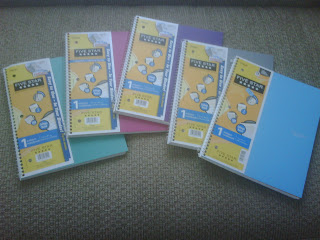 (I am perhaps, a little obsessed with them.) I buy them in every color possible because I have synesthesia and the color of the notebook is important to me. Seriously. Like, my current SNI is in a dark blue notebook. I could never write it in say a red, or lime green one, because the story is most definitely not lime green. Which sounds crazy, but trust me when I say this all makes sense. Anyhoo.
I like to free write.
Generally, I start with the bio of my main character. Most of my ideas start with either a character or a "what if". My current SNI started with a "what if" about a boy. So I knew both the situation and the character.
I label a blank page CHARACTER(S) and scribble down everything I know about this character, and usually, just the act of doing this reveals more and more info about the character and the plot.
After that, I label a new blank page BASIC INFO and write out the basics of the plot starting with a logline, like: A boy does ________ and learns _______. Or whatever. Then I go into more detail. Again, just the act of putting down vague ideas makes them clearer and adds in more detail.
I never pressure myself about this. This is all fun. It's like cleaning out a closet. I try to take every single thought I have about this idea and just get it on paper so that later I can go through it and know what I was thinking, the vibe of the story, etc.
I think in scenes so once I have my character and basic situation (plot) I tend to have a jumble of visual images and emotions of things that happen in the story. I start a new page labeled - can you guess? Yep, SCENES and I try to write out everything I see and hear (my ideas tend to play out like movies in my head) about the scene. I then ask myself, what happened? What lead up to this moment? Why is this happening? What happens after this? I write out all the dialogue I "hear", even if it doesn't totally make sense, because I don't want to miss anything that just might be brilliant.
The best thing about this process is that it opens up my mind to more ideas about the story. I discover new characters, and events within the story world, and that keeps it brewing in the back of my mind while I'm working on what I'm supposed to be doing. I will usually come back several times to add thoughts, new character details, songs for a playlist, etc. It also gives me piece of mind that my story will still be there when I have the time to devote to it.
By the time I'm ready to work on that story, I usually have my main character's voice, all my key scenes and plot twists worked out.
Using a separate notebook for each idea gives me the added bonus of feeling productive. I get a rush when I look at my stack of ideas and know that I have some cool ideas that I'm excited about waiting for me. I don't feel lost, or overwhelmed because I've already done most of the work in just a few minutes of stolen minutes of free time each day.
What about you? Do you have any writing obsessions like my notebooks? What do you do with your Shiny New Ideas?
If you're like me, whenever you're in the middle of doing something that requires all of your focus (say, revising your novel *cough*) that's when you get hit with a Shiny New Idea(!) I find if I don't do something with those ideas, right away, I lose the spark and can't always get it back.
What I do, is as soon as a SNI hits, I write it down. In as much detail as possible. I keep each shiny new idea in it's own notebook. Specifically, Mead Five Star 1 Subject Notebooks, like these:
 (I am perhaps, a little obsessed with them.) I buy them in every color possible because I have synesthesia and the color of the notebook is important to me. Seriously. Like, my current SNI is in a dark blue notebook. I could never write it in say a red, or lime green one, because the story is most definitely not lime green. Which sounds crazy, but trust me when I say this all makes sense. Anyhoo.
I like to free write.
Generally, I start with the bio of my main character. Most of my ideas start with either a character or a "what if". My current SNI started with a "what if" about a boy. So I knew both the situation and the character.
I label a blank page CHARACTER(S) and scribble down everything I know about this character, and usually, just the act of doing this reveals more and more info about the character and the plot.
After that, I label a new blank page BASIC INFO and write out the basics of the plot starting with a logline, like: A boy does ________ and learns _______. Or whatever. Then I go into more detail. Again, just the act of putting down vague ideas makes them clearer and adds in more detail.
I never pressure myself about this. This is all fun. It's like cleaning out a closet. I try to take every single thought I have about this idea and just get it on paper so that later I can go through it and know what I was thinking, the vibe of the story, etc.
I think in scenes so once I have my character and basic situation (plot) I tend to have a jumble of visual images and emotions of things that happen in the story. I start a new page labeled - can you guess? Yep, SCENES and I try to write out everything I see and hear (my ideas tend to play out like movies in my head) about the scene. I then ask myself, what happened? What lead up to this moment? Why is this happening? What happens after this? I write out all the dialogue I "hear", even if it doesn't totally make sense, because I don't want to miss anything that just might be brilliant.
The best thing about this process is that it opens up my mind to more ideas about the story. I discover new characters, and events within the story world, and that keeps it brewing in the back of my mind while I'm working on what I'm supposed to be doing. I will usually come back several times to add thoughts, new character details, songs for a playlist, etc. It also gives me piece of mind that my story will still be there when I have the time to devote to it.
By the time I'm ready to work on that story, I usually have my main character's voice, all my key scenes and plot twists worked out.
Using a separate notebook for each idea gives me the added bonus of feeling productive. I get a rush when I look at my stack of ideas and know that I have some cool ideas that I'm excited about waiting for me. I don't feel lost, or overwhelmed because I've already done most of the work in just a few minutes of stolen minutes of free time each day.
What about you? Do you have any writing obsessions like my notebooks? What do you do with your Shiny New Ideas?
Wednesday, February 17, 2010
The All-Important First Chapter
Last week I entered Miss Snark's First Victim's Secret Agent contest (see my entry here) and got some GREAT feedback on my work. Since the contest deals with the first 250 words, all of which I rewrote for the contest, I thought this was a great time to talk about first chapters.
This is my weekly writing post at my crit partners' blog Sisters In Scribe.
Last summer I attended the Iowa Summer Writing Festival. I took a workshop on first chapters called "Frontloading: The Crucial First Chapter" and the thing I learned that stuck with me the most was that the first chapter is a promise to the reader. It tells them what kind of story they're going to be getting, and what to expect. This is true, even if you don't intend for your first chapter to do that, because it's the way we read. Breaking that promise can frustrate, and disappoint your reader.
That doesn't mean you should give everything away. You don't have to reveal your plot twists, but if your book is a sci-fi thriller, don't let your first chapter read like chick-lit.
By the end of the first chapter, the reader should have some sense of what the main conflict of the book is going to be. They don't need to know all the details, but they should be able to tell the genre, have a good sense of who (what type of person)the main character is, and how their world is changing. Knowing these things sets up anticipation in the reader, it makes them want to read on and see how the events unfold. Not knowing these things makes the reader wonder what the heck this book is about, and if they should even bother to read on and see what happens.
EXAMPLE:
Here's an example of a book with a great first chapter:
The Hunger Games - In the first chapter of The Hunger Games we get to see Katniss' everyday world. We learn about the Hunger Games and the Reaping and the high chance that Gale and Katniss will be picked. We see that Katniss is responsible and protective of her sister, Prim, whose name is in the Reaping for the first time. And in the very last sentence of the chapter there's a shock as Prim's name is called. This is a GREAT end of a first chapter. As a reader we are left with a sense of dread. We know what Katniss must do, and we know that we're in for an exciting ride because we're going to experience the Hunger Games with Katniss. We're also introduced to the mechanics of Collin's writing - cliffhanger chapters. Both with story and with structure, she has shown us what to expect, and how to read her book. And she delivers. (Seriously, if you have not read this book yet, go get it NOW.)
Now imagine if The Hunger Games started differently. What if the first chapter was an ordinary day at school for Katniss, followed by time at home dealing with her mother and sister. Suzanne Collins could've started there and gone into greater detail about Katniss' troubled relationship with her mom, given us more history on the District, how life in The Seam works, etc. She could've had the Reaping happen in chapter 3. If she had though, she probably would've lost a lot of readers. I know I would've been flipping back to the cover over and over again, wondering when these supposedly awesome Hunger Games were going to start. I probably would've put the book down before the action started and picked up something else.
The first chapter is the last chapter in disguise.
- Richard Peck
I read this quote for the first time not long ago and was struck by how true it was. Richard Peck says that when he finishes his first draft, he always throws out the first chapter without reading it and writes a new one.
I thought about why it is that the first chapter is usually the one that needs the most work and I think I figured out at least part of why this is true.
Usually, at the beginning of a story I am bursting with ideas and information. I know my main character is this, and her love interest is that, and then this, this, and this are going to happen, all because of THAT! And so I'm excited to get to that stuff, and I start laying down all the pieces and facts necessary for the later events to occur.
I've come to realize the first chapter, (and the whole first draft really) but especially in the first draft, the first chapter is really just notes to myself. It's me getting that info out there so that I can remember to make it happen when the time comes.
After the first chapter, my writing tends to smooth out. I let things unfold the way they should, revealing information only when it's necessary. Most of the time this results in duplicate information. Things appear once, in the first chapter where they're not really needed, and again later on where they belong.
How to fix your first chapter.
I'm no expert, but here are a few tips that work for me:
You know you're on the right track if people have a sense of where your book is going to go and they want to go along with it.
What about you? What are some of your first chapter tips? What are some of your favorite first chapters?
This is my weekly writing post at my crit partners' blog Sisters In Scribe.
Last summer I attended the Iowa Summer Writing Festival. I took a workshop on first chapters called "Frontloading: The Crucial First Chapter" and the thing I learned that stuck with me the most was that the first chapter is a promise to the reader. It tells them what kind of story they're going to be getting, and what to expect. This is true, even if you don't intend for your first chapter to do that, because it's the way we read. Breaking that promise can frustrate, and disappoint your reader.
That doesn't mean you should give everything away. You don't have to reveal your plot twists, but if your book is a sci-fi thriller, don't let your first chapter read like chick-lit.
By the end of the first chapter, the reader should have some sense of what the main conflict of the book is going to be. They don't need to know all the details, but they should be able to tell the genre, have a good sense of who (what type of person)the main character is, and how their world is changing. Knowing these things sets up anticipation in the reader, it makes them want to read on and see how the events unfold. Not knowing these things makes the reader wonder what the heck this book is about, and if they should even bother to read on and see what happens.
EXAMPLE:
Here's an example of a book with a great first chapter:
The Hunger Games - In the first chapter of The Hunger Games we get to see Katniss' everyday world. We learn about the Hunger Games and the Reaping and the high chance that Gale and Katniss will be picked. We see that Katniss is responsible and protective of her sister, Prim, whose name is in the Reaping for the first time. And in the very last sentence of the chapter there's a shock as Prim's name is called. This is a GREAT end of a first chapter. As a reader we are left with a sense of dread. We know what Katniss must do, and we know that we're in for an exciting ride because we're going to experience the Hunger Games with Katniss. We're also introduced to the mechanics of Collin's writing - cliffhanger chapters. Both with story and with structure, she has shown us what to expect, and how to read her book. And she delivers. (Seriously, if you have not read this book yet, go get it NOW.)
Now imagine if The Hunger Games started differently. What if the first chapter was an ordinary day at school for Katniss, followed by time at home dealing with her mother and sister. Suzanne Collins could've started there and gone into greater detail about Katniss' troubled relationship with her mom, given us more history on the District, how life in The Seam works, etc. She could've had the Reaping happen in chapter 3. If she had though, she probably would've lost a lot of readers. I know I would've been flipping back to the cover over and over again, wondering when these supposedly awesome Hunger Games were going to start. I probably would've put the book down before the action started and picked up something else.
- Richard Peck
I read this quote for the first time not long ago and was struck by how true it was. Richard Peck says that when he finishes his first draft, he always throws out the first chapter without reading it and writes a new one.
I thought about why it is that the first chapter is usually the one that needs the most work and I think I figured out at least part of why this is true.
Usually, at the beginning of a story I am bursting with ideas and information. I know my main character is this, and her love interest is that, and then this, this, and this are going to happen, all because of THAT! And so I'm excited to get to that stuff, and I start laying down all the pieces and facts necessary for the later events to occur.
I've come to realize the first chapter, (and the whole first draft really) but especially in the first draft, the first chapter is really just notes to myself. It's me getting that info out there so that I can remember to make it happen when the time comes.
After the first chapter, my writing tends to smooth out. I let things unfold the way they should, revealing information only when it's necessary. Most of the time this results in duplicate information. Things appear once, in the first chapter where they're not really needed, and again later on where they belong.
How to fix your first chapter.
I'm no expert, but here are a few tips that work for me:
- Rewrite it from scratch.
- Look for and remove exposition that doesn't come into play until later in the story.
- Start at the moment closest to the beginning of the main conflict of your story as possible.
- Make sure your chapter has action, and not just a character thinking about or looking at stuff.
- Make sure the main conflict of your book is set up.
- Ask people to read the first chapter by itself. What do they think the book is about? Do they want to keep reading?
You know you're on the right track if people have a sense of where your book is going to go and they want to go along with it.
What about you? What are some of your first chapter tips? What are some of your favorite first chapters?
Wednesday, December 30, 2009
Writing Tip: Uncertainty - why it (sometimes) sucks!
Wednesday is my day to post over at my critique group's blog Sisters in Scribe. If you haven't checked it out yet, you should. My partners post some really interesting stuff. Since we're just getting started, I thought I would share my post this week here on my blog as well. Here goes:
Recently I read a really good book. Really good! It was full of action, adventure, drama, suspense, and emotion, and it was also full of one of my pet peeves. The dreaded uncertainty that is seemed like, appeared as if, almost.
You know what I'm talking about. One character says to the MC, "I hate you!" and the MC's inner monologue says "He punched the wall, as if he was angry." Really? It was like he was angry, but you're not sure if that was it? Maybe he just likes punching walls? Maybe wall-punching means happiness?
This occasionally drives me insane.
I notice this happens most often in books written in close third person. I think it's because when writing in first person it's easier to slip into the character's distinct point of view and feel what they're feeling.
Think about it. In your own life, if someone shouts at you "I hate you!" and then punches a wall, you have a strong instant reaction. You don't think to yourself, "I wonder if he's angry?" You think, "Whoa, this dude is pissed!" Even if you're wrong, and he does just like to punch walls for no reason, you have interpreted his words and actions and made a decision on what they mean.
Characters are like this too. They jump to conclusions. They reason out why things are happening. I know that, especially in third person, there's a fine line between staying in one character's close POV and crossing into another's. This is where the trouble starts. Writers worry that if they say too much about what is happening, or how someone is feeling that they are switching POVs or crossing over into omniscience. I say, HOGWASH!
While it's true that unless your main character is a mind reader, he can't know what others are thinking. He can definitely take an educated guess or decide for himself how to interpret what he sees. When I see a lot of this in a manuscript I'm critiquing, I always write "Be authoritative!" and "Either it happened or it didn't. Which is it?"
Don't tell me "It seemed like the door opened all by itself." When I see this type of sentence structure, I expect a "but". As in "It seemed like the door opened all by itself, but it was just the cat leaning against it." When you leave the sentence as "It seemed like the door opened all by itself." and the character doesn't do any exploring to find out how it actually did open, I'm left wondering, did the door open by itself or not? You know whether it did or not, why not share? Your character, having witnessed this event, should have come to a decision about whether or not the door opened on it's own - even if it's the wrong answer. And if your character really can't tell if it opened by itself or not, then he needs to try and find out why (or run away in terror, whichever he's more prone to do).
I may be in the minority here, but I think it's best for your character to see things through his own world view and save the uncertainty for when he really doesn't know what's going on. If you stay focused and true to your character's personality and voice, it should be clear, even in third person, that what he sees happening is what he thinks is happening, and not absolute fact. To me this is one of the best things about telling a story through one person's eyes. Each character has a unique way of seeing things. What one character thinks is evil spirits haunting his house, another thinks is just the wind. Find out what it really is is what storytelling is all about!
Recently I read a really good book. Really good! It was full of action, adventure, drama, suspense, and emotion, and it was also full of one of my pet peeves. The dreaded uncertainty that is seemed like, appeared as if, almost.
You know what I'm talking about. One character says to the MC, "I hate you!" and the MC's inner monologue says "He punched the wall, as if he was angry." Really? It was like he was angry, but you're not sure if that was it? Maybe he just likes punching walls? Maybe wall-punching means happiness?
This occasionally drives me insane.
I notice this happens most often in books written in close third person. I think it's because when writing in first person it's easier to slip into the character's distinct point of view and feel what they're feeling.
Think about it. In your own life, if someone shouts at you "I hate you!" and then punches a wall, you have a strong instant reaction. You don't think to yourself, "I wonder if he's angry?" You think, "Whoa, this dude is pissed!" Even if you're wrong, and he does just like to punch walls for no reason, you have interpreted his words and actions and made a decision on what they mean.
Characters are like this too. They jump to conclusions. They reason out why things are happening. I know that, especially in third person, there's a fine line between staying in one character's close POV and crossing into another's. This is where the trouble starts. Writers worry that if they say too much about what is happening, or how someone is feeling that they are switching POVs or crossing over into omniscience. I say, HOGWASH!
While it's true that unless your main character is a mind reader, he can't know what others are thinking. He can definitely take an educated guess or decide for himself how to interpret what he sees. When I see a lot of this in a manuscript I'm critiquing, I always write "Be authoritative!" and "Either it happened or it didn't. Which is it?"
Don't tell me "It seemed like the door opened all by itself." When I see this type of sentence structure, I expect a "but". As in "It seemed like the door opened all by itself, but it was just the cat leaning against it." When you leave the sentence as "It seemed like the door opened all by itself." and the character doesn't do any exploring to find out how it actually did open, I'm left wondering, did the door open by itself or not? You know whether it did or not, why not share? Your character, having witnessed this event, should have come to a decision about whether or not the door opened on it's own - even if it's the wrong answer. And if your character really can't tell if it opened by itself or not, then he needs to try and find out why (or run away in terror, whichever he's more prone to do).
I may be in the minority here, but I think it's best for your character to see things through his own world view and save the uncertainty for when he really doesn't know what's going on. If you stay focused and true to your character's personality and voice, it should be clear, even in third person, that what he sees happening is what he thinks is happening, and not absolute fact. To me this is one of the best things about telling a story through one person's eyes. Each character has a unique way of seeing things. What one character thinks is evil spirits haunting his house, another thinks is just the wind. Find out what it really is is what storytelling is all about!
Monday, August 17, 2009
Revising Tips
Rachelle Gardner has a great post on her blog today about tightening up your manuscript.
It's funny how many of these (particularly adverbs, too many adjectives, and the elusive passive sentence) I can spot so easily in my crit group's work and then fill up my manuscript with the same thing and not even notice!
Read her great tips here!
It's funny how many of these (particularly adverbs, too many adjectives, and the elusive passive sentence) I can spot so easily in my crit group's work and then fill up my manuscript with the same thing and not even notice!
Read her great tips here!
Subscribe to:
Posts (Atom)